Don't Move: AI Accelerates Corporate Layoffs While Workers Cling to Their Desks
Tech giants are shedding jobs to fund AI infrastructure, creating a frozen labor market where terrified employees refuse to quit.
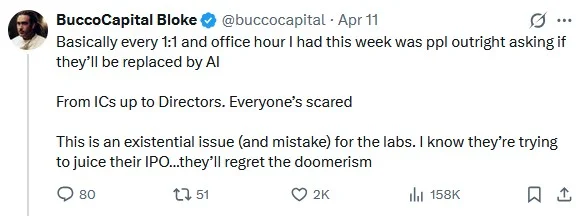
In Jurassic Park the characters froze so the T-Rex couldn't see them. That's what it feels like in the job market right now. Whether AI is actually automating away jobs, or it's just a convenient excuse, the result is the same: workers are afraid to move.
The AI Capital Reallocation
This is not a traditional recessionary layoff wave. It is a deliberate, strategic reallocation of capital. According to recent reporting from Business Insider, highly profitable tech behemoths like Meta, Amazon, and Oracle are actively shedding workers to pivot resources toward artificial intelligence. They are cannibalizing their legacy projects and human headcounts to buy GPUs, build data centers, and train the next generation of foundational models.
This trend extends far beyond Silicon Valley. As noted by Financial Express, over 100 companies including traditional enterprise giants like Citi and Dell are planning workforce reductions driven by automation and cost-cutting measures. The World Economic Forum's warning that 41% of companies expect to reduce their workforces due to AI is no longer a distant projection; it is the current operational playbook. Corporations have realized that the fastest way to appease shareholders and fund their AI ambitions is to reduce headcount.
The Death of Worker Mobility
If corporations are moving fast and breaking things, workers are doing the exact opposite. They are frozen. Data highlighted by HR Dive reveals that U.S. worker quit rates have plummeted to a ten-year low. The "Great Resignation" of the early 2020s feels like a fever dream. Today, the labor market is defined by fear.
StaffingHub puts hard numbers to this psychological shift: 62% of workers are now choosing job security over seeking new opportunities, driving the quit rate down to 2%. Employees are looking around, seeing the headlines about AI-driven layoffs at major firms, and deciding to hunker down. They lack the confidence to test the job market because they know that the roles they might apply for are precisely the ones being targeted for automation. This creates a standoff: workers are miserable but trapped, clinging to desks that their employers are actively trying to eliminate.
The Temp Buffer
While full-time, permanent hiring softens, an interesting counter-trend is emerging in the staffing sector. StaffingHub notes that temporary help employment is actually ticking up marginally. Employers are holding their breath too.
Why commit to a full-time, salaried employee with benefits when an AI agent might be able to handle that workload in 12 to 18 months? Instead, companies are utilizing temporary and contract workers to bridge the gap between human labor and full automation. This shifts the risk entirely onto the worker. The labor market is slowly being bifurcated into a small class of highly paid AI engineers and executives, and a growing underclass of precarious, short-term contractors who are merely keeping the seat warm for an algorithm.
The Takeaway
Is this just life for the next decade? We're optimistic it's not.
95% of companies who have attempted to implement AI have seen no significant business impact. Most companies also seem to be trying to buy AI like they did traditional software. The companies having success are treating AI like new employees. Think: AI does the work, employee audits for accuracy, not AI-human collaboration.
As best practices get discovered and copied, more than 5% will start seeing positive ROI from AI. At that point hopefully we can collectively take a breath. As we discover the boundary of what AI can and can't do, there will be increasingly clear skills and tasks that humans will continue to do.
Many people's AI strategy is to ignore it and hope it goes away. We prefer to track it. You can also track it with us here.