Judges, Magistrate Judges, and Magistrates
Arbitrate, advise, adjudicate, or administer justice in a court of law. May sentence defendant in criminal cases according to government statutes or sentencing guidelines. May determine liability of defendant in civil cases. May perform wedding ceremonies.
How AI Impacts Each Task
21 tasks analyzed
Rule on custody and access disputes, and enforce court orders regarding custody and support of children.
Read documents on pleadings and motions to ascertain facts and issues.
Sentence defendants in criminal cases, on conviction by jury, according to applicable government statutes.
Grant divorces and divide assets between spouses.
Rule on admissibility of evidence and methods of conducting testimony.
Instruct juries on applicable laws, direct juries to deduce the facts from the evidence presented, and hear their verdicts.
Award compensation for damages to litigants in civil cases in relation to findings by juries or by the court.
Monitor proceedings to ensure that all applicable rules and procedures are followed.
Preside over hearings and listen to allegations made by plaintiffs to determine whether the evidence supports the charges.
Research legal issues and write opinions on the issues.
Write decisions on cases.
Participate in judicial tribunals to help resolve disputes.
Advise attorneys, juries, litigants, and court personnel regarding conduct, issues, and proceedings.
Interpret and enforce rules of procedure or establish new rules in situations where there are no procedures already established by law.
Settle disputes between opposing attorneys.
Conduct preliminary hearings to decide issues such as whether there is reasonable and probable cause to hold defendants in felony cases.
Impose restrictions upon parties in civil cases until trials can be held.
Supervise other judges, court officers, and the court's administrative staff.
Provide information regarding the judicial system or other legal issues through the media and public speeches.
Perform wedding ceremonies.
Issue arrest warrants.
| Task | AI Capability | Risk | Time % | |
|---|---|---|---|---|
| Rule on custody and access disputes, and enforce court orders regarding custody and support of children. | 15Estimated | 33.0% | 5% | |
| Read documents on pleadings and motions to ascertain facts and issues. | 46.4Observed | 45.6% | 9% | |
| Sentence defendants in criminal cases, on conviction by jury, according to applicable government statutes. | 20Estimated | 35.0% | 5% | |
| Grant divorces and divide assets between spouses. | 35Estimated | 41.0% | 4% | |
| Rule on admissibility of evidence and methods of conducting testimony. | 25Estimated | 37.0% | 6% | |
| Instruct juries on applicable laws, direct juries to deduce the facts from the evidence presented, and hear their verdicts. | 5Estimated | 17.0% | 4% | |
| Award compensation for damages to litigants in civil cases in relation to findings by juries or by the court. | 35Estimated | 41.0% | 4% | |
| Monitor proceedings to ensure that all applicable rules and procedures are followed. | 20Estimated | 35.0% | 7% | |
| Preside over hearings and listen to allegations made by plaintiffs to determine whether the evidence supports the charges. | 10Estimated | 31.0% | 7% | |
| Research legal issues and write opinions on the issues. | 55.67Observed | 49.3% | 8% | |
| Write decisions on cases. | 52Observed | 47.8% | 8% | |
| Participate in judicial tribunals to help resolve disputes. | 5Estimated | 17.0% | 3% | |
| Advise attorneys, juries, litigants, and court personnel regarding conduct, issues, and proceedings. | 5Estimated | 17.0% | 5% | |
| Interpret and enforce rules of procedure or establish new rules in situations where there are no procedures already established by law. | 20Estimated | 35.0% | 4% | |
| Settle disputes between opposing attorneys. | 5Estimated | 17.0% | 4% | |
| Conduct preliminary hearings to decide issues such as whether there is reasonable and probable cause to hold defendants in felony cases. | 15Estimated | 33.0% | 4% | |
| Impose restrictions upon parties in civil cases until trials can be held. | 20Estimated | 35.0% | 3% | |
| Supervise other judges, court officers, and the court's administrative staff. | 5Estimated | 17.0% | 3% | |
| Provide information regarding the judicial system or other legal issues through the media and public speeches. | 54.7Observed | 36.9% | 2% | |
| Perform wedding ceremonies. | 5Estimated | 17.0% | 2% | |
| Issue arrest warrants. | 20Estimated | 35.0% | 3% |
Skill Impact Analysis
AI-Vulnerable Skills (6)
High reliance on Reading Comprehension is a risk area. Consider developing complementary AI-resistant skills to maintain value.
High reliance on Information Ordering is a risk area. Consider developing complementary AI-resistant skills to maintain value.
Memorization is AI-vulnerable but has moderate importance in this role. AI tools may handle this; focus on higher-value skills.
Mathematics is AI-vulnerable but has moderate importance in this role. AI tools may handle this; focus on higher-value skills.
Mathematics is AI-vulnerable but has moderate importance in this role. AI tools may handle this; focus on higher-value skills.
Programming is AI-vulnerable but has moderate importance in this role. AI tools may handle this; focus on higher-value skills.
AI-Resistant Skills (11)
Leadership is AI-resistant — strengthening this skill provides durable career protection.
Adaptability/Flexibility is AI-resistant — strengthening this skill provides durable career protection.
Complex Problem Solving is AI-resistant — strengthening this skill provides durable career protection.
Social Perceptiveness is AI-resistant — strengthening this skill provides durable career protection.
Negotiation is AI-resistant — strengthening this skill provides durable career protection.
Persuasion is AI-resistant — strengthening this skill provides durable career protection.
Instructing is AI-resistant — strengthening this skill provides durable career protection.
Coordination is AI-resistant — strengthening this skill provides durable career protection.
Recommended Courses
Courses matched to Judges, Magistrate Judges, and Magistrates skill gaps, ranked by relevance to your displacement risk profile.
Get personalized recommendations. Answer a few questions about your experience and skills to get course suggestions tailored specifically to you.
Upskill to Reduce Risk
Courses addressing your most AI-vulnerable skills
SQL Fundamentals Skill Track
by DataCamp
Estimated Impact
AI-Augmentation Tools
Learn to work alongside AI and boost your productivity
Google UX Design Professional Certificate
by Google
Estimated Impact
Strengthen Your Edge
Double down on skills AI can't replicate
Leading People and Teams Specialization
by University of Michigan
Estimated Impact
We may earn a commission when you enroll through our links, at no extra cost to you. This helps fund the Takeover Tracker.
Risk reduction and salary impact are estimates based on skill gap analysis, course relevance, and labor market data. Actual results vary by individual circumstance.
Alternate Career Paths
See all transitionsAdministrative Law Judges, Adjudicators, and Hearing Officers
28%Median salary: $115,230
Higher risk than 27% of other occupations
Arbitrators, Mediators, and Conciliators
29%Median salary: $67,710
Higher risk than 34% of other occupations
Criminal Justice and Law Enforcement Teachers, Postsecondary
33%Median salary: $71,470
Higher risk than 58% of other occupations
Equal Opportunity Representatives and Officers
32%Median salary: $78,420
Higher risk than 51% of other occupations
Judicial Law Clerks
36%Median salary: $60,400
Higher risk than 69% of other occupations
Law Teachers, Postsecondary
31%Median salary: $126,650
Higher risk than 43% of other occupations
Lawyers
26%Median salary: $151,160
Higher risk than 22% of other occupations
Political Scientists
34%Median salary: $139,380
Higher risk than 60% of other occupations
Probation Officers and Correctional Treatment Specialists
33%Median salary: $64,520
Higher risk than 58% of other occupations
Score History
Risk score over 2 scoring runs
overall change
Education & Training
Percentage of workers at each education and training level
Education Level
Prior Experience Needed
Work experience required to enter this job
Training Provided After Hiring
How long it typically takes to learn on the job
Related News
Recent articles about AI affecting this occupation

Tasmanian justice department review under way after AI and fake citation used in murderer’s parole decision
A convicted killer's parole condition was invalidated because the board relied on non-existent case law generated by artificial intelligence. The critical error has triggered a formal government review into how legal officials are using generative tools.
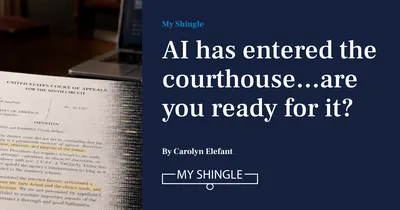
How Legal Professionals Must Adapt to AI-Assisted Court Opinions
Legal professionals must now develop skills to read and evaluate judicial opinions that may have been drafted with artificial intelligence. The shift requires a new level of scrutiny to identify potential AI hallucinations or flawed legal reasoning in official court documents.

Legal AI Pioneer Joins Clio to Build Automation Technology for Courts
Casetext cofounder Pablo Arredondo is joining legal tech giant Clio to develop AI tools specifically for court systems. This signals a major push to automate judicial workflows and administrative legal tasks.
Last scored March 14, 2026 · Based on BLS employment data and O*NET task analysis